How to Select the Right Hybrid Stepper Motor for Your Automated Packaging Line
Navigating the Critical Choice for Packaging Automation
The global push for efficiency and flexibility in manufacturing is driving unprecedented demand for automated packaging lines. As of early 2026, industry reports highlight a surge in investments for smart, modular packaging systems capable of handling diverse product sizes and high-speed operations. At the heart of these systems lies a critical component: the Hybrid Stepper Motor. Selecting the correct motor is not merely a technical specification check; it's a strategic decision impacting throughput, reliability, and total cost of ownership. This guide will walk you through the key considerations for choosing the optimal Hybrid Stepper Motor for your automated packaging application, ensuring your line performs at its peak.
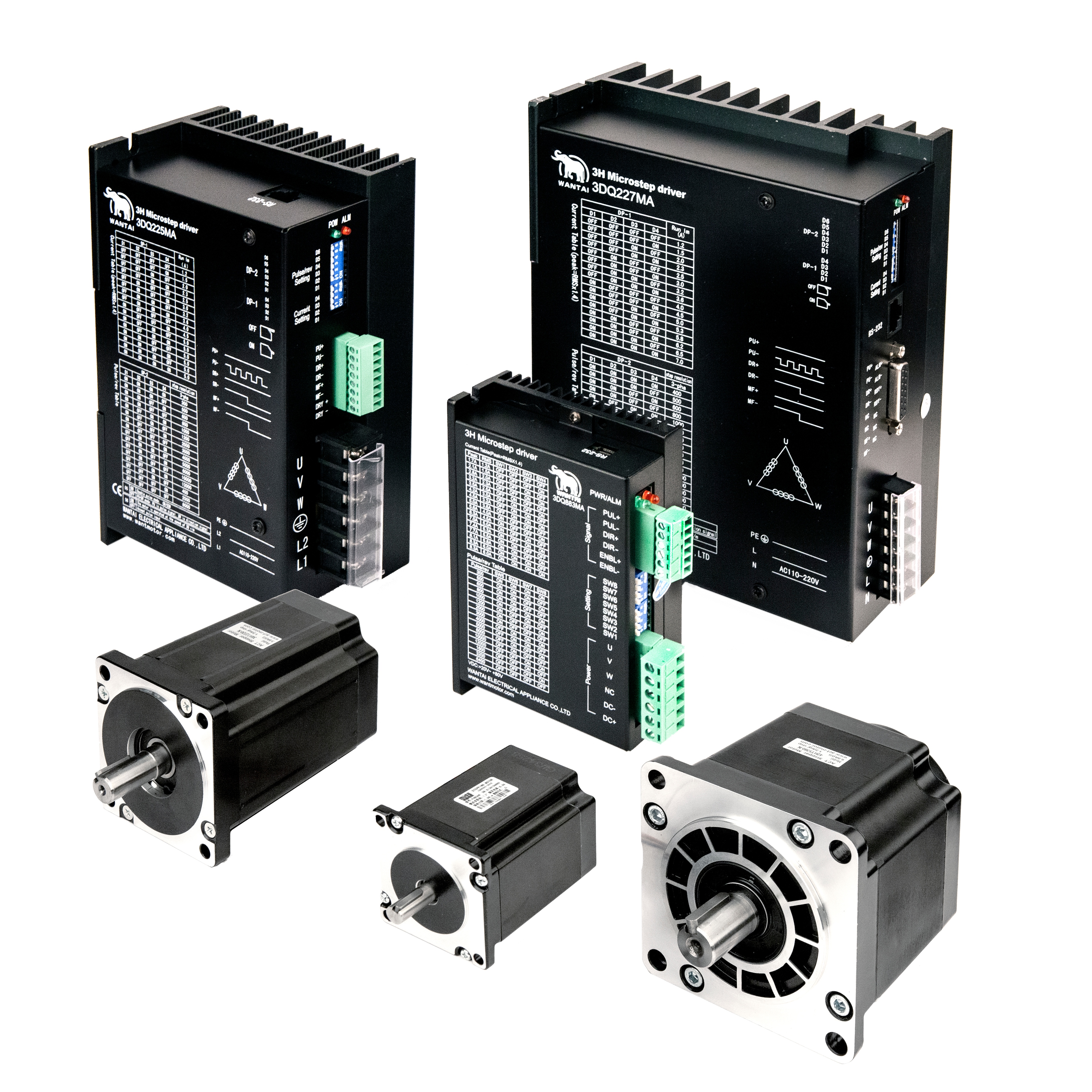
A reliable stepper motor and driver system forms the core of precise motion control in packaging machinery.
Step 1: Define Your Core Application Requirements
Begin by analyzing the specific motion task within your packaging line. Different stages demand different motor characteristics.
- High-Speed Pick-and-Place or Filling: This requires rapid acceleration and deceleration. Look for motors with low rotor inertia and high torque at speed. NEMA8 Hybrid Stepper Motors or 8HS Hybrid Stepper Motors can be excellent for smaller, high-speed gantry systems.
- Precision Carton Erection or Sealing: This involves high force for brief periods. A High-torque stepper motor is essential. Consider Geared Stepper Motors or Gearbox stepper motors to multiply the output torque from a compact motor frame, perfect for applying consistent pressure in sealers.
- Linear Motion for Pushers or Conveyor Indexing: For converting rotary motion to precise linear movement, Lead Screw Stepper Motors or ball screw stepper motors are the integrated solution. They are ideal for the precise pushing action required in a Logistics Sorter Pushing Hybrid Stepper Motor application.
- Vertical Axis or Load-Holding: Any axis that must hold position against gravity (like a lifting arm) when power is off requires a Brake Stepper Motor. This is a critical safety and functionality feature.
Step 2: Calculate Torque and Speed Demands
This is the most technical step. You must calculate the required torque to accelerate your load (mass) and overcome friction. Remember, a stepper motor's torque decreases as speed increases (torque-speed curve).
- Peak Torque: Determine the torque needed for the highest acceleration point in your cycle.
- Continuous Torque: Calculate the torque required to run at your operational speed against constant friction.
- Speed (RPM): Define the maximum operational speed.
Always select a motor whose torque-speed curve provides a 30-50% margin above your calculated requirements. This prevents stalling and ensures long-term reliability. For complex dynamic loads, an Intelligent Load-Adaptive Hybrid Stepper Motor system, which can adjust current based on real-time load, can prevent stalling and improve efficiency.
Step 3: Choose the Right Driver and Control Mode
The motor is only half the system. The Stepper Motor Driver dictates performance. For packaging lines, consider these driver features:
- Microstepping: Higher microstepping (e.g., 25600 steps/rev) provides smoother motion, reduced vibration, and quieter operation—crucial for high-speed lines.
- Closed-Loop Capability: For mission-critical stations where missed steps are unacceptable, specify a closed-loop stepper motor system or a stepper motor with encoder. This technology, like the systems offered by ACT MOTOR, provides feedback to the driver, ensuring position accuracy and compensating for load variations. This is becoming a standard for industrial robots within packaging cells.
- Communication Interface: Ensure the driver supports your line's control network (EtherCAT, PROFINET, Modbus TCP/IP, or simple pulse/direction).
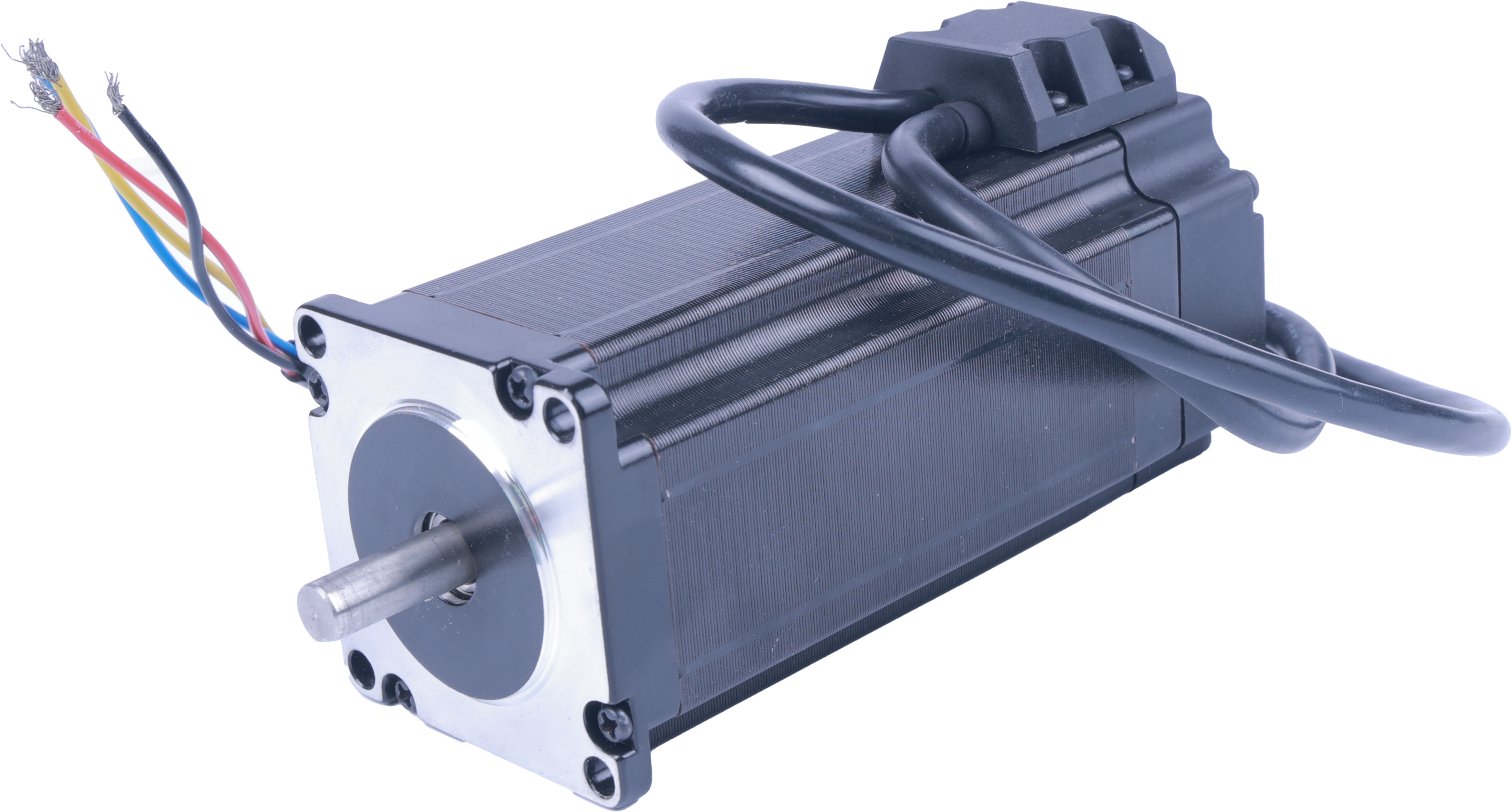
Modern closed-loop stepper systems ensure reliability and precision in demanding automation tasks.
Step 4: Consider Mechanical Integration and Environment
How will the motor fit into your machine?
- Frame Size (NEMA): Standardized mounting dimensions (NEMA 17, 23, 34) are key. Ensure your design accommodates the chosen frame.
- Integrated Solutions: Integrated stepper motors combine the motor, lead screw, and sometimes the driver into one unit, simplifying design and assembly. ACT MOTOR provides a range of such precision modules.
- Environmental Factors: Packaging environments can have dust, moisture, or washdown requirements. While many standard ROHS-Compliant Stepper Motors are suitable, confirm IP ratings if necessary.
Step 5: Prioritize Quality and Compliance
In an industrial setting, motor failure leads to costly downtime. Your selection criteria must include:
- Manufacturing Quality: Choose a supplier with robust processes. For example, Changzhou ACT Motor Co., Ltd. operates over 70,000 square meters of modern production facilities with full quality control from raw materials to finished goods.
- Certifications: Look for IS09001 Stepper Motors from a company with ISO9001 certification. This ensures a quality management system is in place. Compliance with international standards like CE (for safety and EMC) and RoHS (for hazardous substances) is non-negotiable for global markets. ACT MOTOR holds these certifications, providing assurance of product reliability and market access.
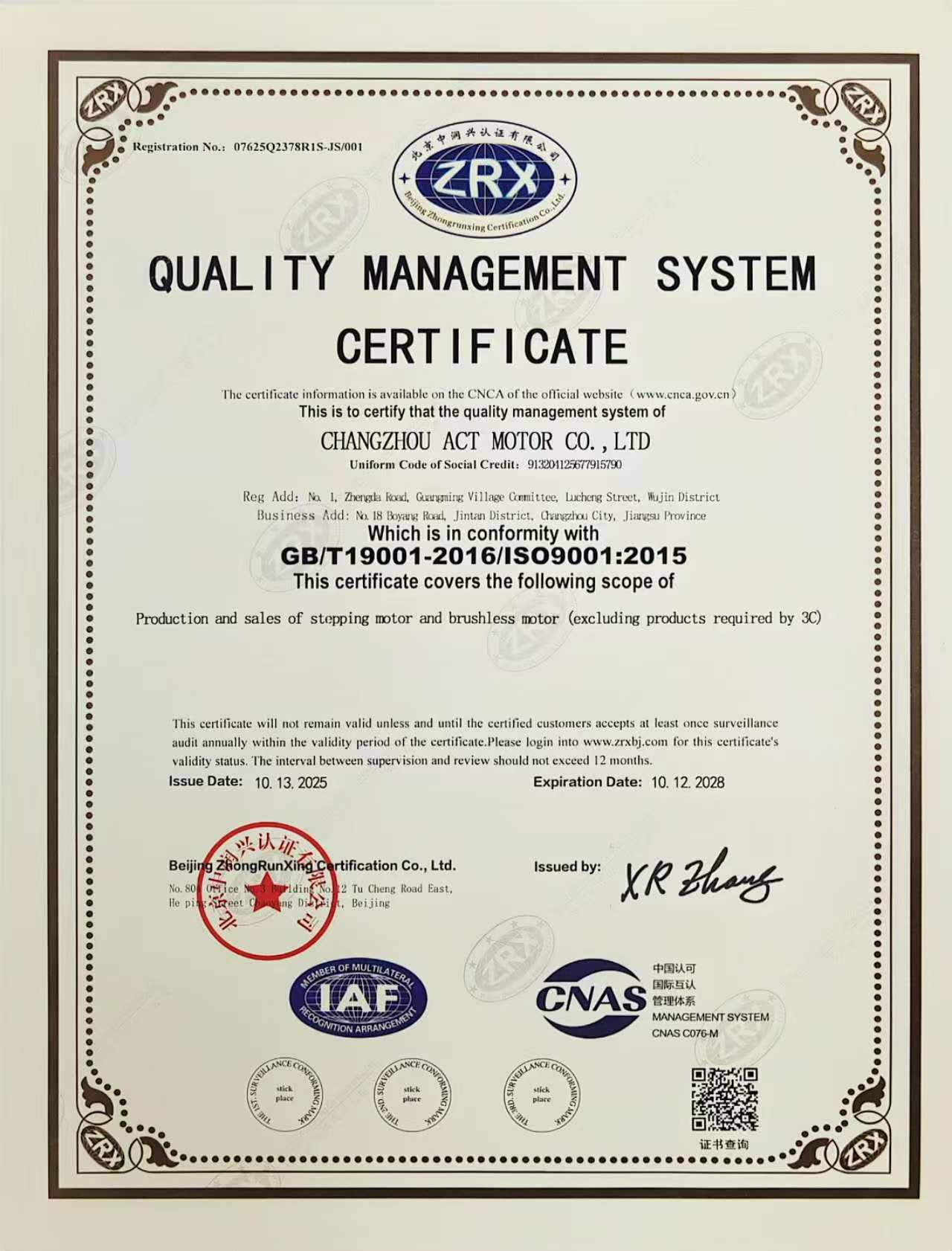
ISO 9001 certification is a fundamental indicator of a manufacturer's commitment to consistent quality.
Step 6: Evaluate the Supplier's Support Ecosystem
The relationship with your motor supplier shouldn't end at purchase.
- Technical Support: Can they help with sizing, integration, and troubleshooting?
- Global Availability: Do they have local stock or support? ACT MOTOR, for instance, maintains a branch in Bremen, Germany, for European market support, alongside offices in Shanghai and Jinan, ensuring responsive service.
- Product Range: A supplier with a broad portfolio, including stepper motors for textile machinery, stepper motors for syringe pumps, and Medical Equipment Hybrid Stepper Motor solutions, likely has deep application expertise you can leverage.
Conclusion: Partnering for Performance
Selecting the right Hybrid Stepper Motor is a multifaceted process balancing technical specs, mechanical fit, quality, and supplier capability. By following these steps, you move from guesswork to a data-driven selection that maximizes your packaging line's performance and reliability.
For engineers designing the next generation of automated packaging lines, partnering with an experienced and certified manufacturer like ACT MOTOR provides a significant advantage. With their comprehensive range of High-Precision Hybrid Stepper Motor solutions, from basic models to advanced closed-loop and integrated systems, they offer the core power support needed for global industrial automation. Visit www.act-motor.com to explore their product portfolio or contact their team at market@act-motor.com / Phone/WhatsApp: +86 13961261588 for application-specific guidance.
Have Questions or Need More Details?
Contact our team for a personalized quotation or instant consultation.
Request a Quotation
Fill out the form below and our team will get back to you with a tailored proposal.
WhatsApp Direct Chat
Prefer to chat in real-time? Message us on WhatsApp for instant assistance & quick answers.
- Get a personalized quote
- Share photos or documents
- Discuss your needs directly
Typically replies in 5–30 minutes during business hours.