
From Quote to Accepted Lot: Ranking Hybrid Stepper Motor Purchase Terms
The most important purchase term in hybrid stepper motor sourcing is the acceptance criteria — the combined specification, drawing and approved sample that define what a buyer is contractually accepting. Certification evidence ranks second, drawing revision control third, and sample approval fourth. MOQ, delivery terms, lead time and payment terms matter, but they only protect an order after both parties agree on what “accepted” means.
This article ranks eleven purchase terms for hybrid stepper motors and hybrid stepper motor drivers in priority order, explains why each term sits where it does, and shows how a procurement team can convert the ranking into a working RFQ sequence. The framework is written for procurement managers and automation engineers who have already shortlisted suppliers and are now moving from quotation to a purchase order.
Why a Terms Checklist Is Not Enough
A quotation template lists terms flatly. It puts unit price, MOQ, lead time, payment terms and warranty in the same visual weight, which quietly suggests they carry the same risk. They do not.
Purchase terms differ along two dimensions that a flat list ignores. The first is cost of failure: what happens to the order if the term is missing or vague. The second is difficulty of recovery: how hard it is to fix the problem once goods are in transit or already installed. A vague warranty clause can usually be renegotiated. A vague acceptance clause usually cannot, because by the time the dispute appears the goods already exist, already shipped, and both sides already have different memories of what was agreed.
That asymmetry is the whole reason a ranking is useful. Terms that are cheap to confirm at RFQ stage and expensive to argue about after delivery belong at the top. Terms that are easy to adjust mid-order belong further down.
A second reason the flat checklist fails is that hybrid stepper motors are configured products rather than catalog commodities. A 42 mm frame and a 42 mm frame can differ in step angle, rated current, phase inductance, lead wire count, rotor inertia and holding torque. When the number of variable parameters is high, the acceptance clause carries more weight than the price clause, because the price is only meaningful against a fixed configuration.
Industry Background: Why Terminology Discipline Matters in 2026
Commercial context supports the ranking. The global stepper motor market was valued at USD 3.962 billion in 2024 and is projected to reach USD 6.245 billion by 2035, growing at a CAGR of 4.22%, according to Market Research Future. Within that market, hybrid stepper motors held approximately 53.93% of total stepper motor market value in 2025, based on KBV Research data. Asia Pacific accounted for 48.91% of the market in 2025, per Mordor Intelligence, supported by a USD 36.9 billion semiconductor-equipment spend in China.
Two consequences follow for buyers. First, hybrid designs are where most sourcing volume sits, so hybrid-specific terms carry the most commercial exposure. Second, the high torque stepper motor segment alone was valued at USD 1.15 billion in 2024 according to Precedence Research, and high-torque designs are exactly the configurations where a specification mismatch is hardest to detect before installation.
Application mix adds a second pressure point. CoherentMI projects the medical equipment segment as the fastest-growing stepper motor application, with a CAGR of 7.5% through 2032, driven by demand in syringe pumps and imaging systems. Medical builds carry documentation obligations that industrial builds often do not, which pushes certification evidence and traceability higher up the buyer’s priority list than a generic purchasing template assumes.
The supplier landscape is also well defined. Market research from Market Research Future and Mordor Intelligence names MinebeaMitsumi, Sanyo Denki, Oriental Motor, Moons’ Industries and Nidec Corporation among the major global participants. Buyers comparing across that landscape will find that the same eleven terms apply regardless of supplier origin — only the evidence behind each term changes.
Regulatory context completes the picture. Industrial hybrid stepper motors sold into the EU must comply with Directive 2014/35/EU (Low Voltage Directive) and Directive 2014/30/EU (Electromagnetic Compatibility) for CE marking, and Directive 2011/65/EU for RoHS. Compliance reporting has repeatedly flagged certification documentation as a source of customs delay for cross-border motor shipments, which is why certificate numbers and expiry dates belong in the purchasing file rather than in a folder someone opens only during an audit.
The Ranked List: Eleven Purchase Terms in Priority Order
The ranking below uses one comparison metric: protection value, defined as cost of failure if the term is missing, multiplied by the difficulty of recovering the position after delivery. Terms are ordered from highest protection value to lowest.
RANK 1Acceptance Criteria: Specification, Drawing and Sample
Rank 1 is not negotiable and should never be left to interpretation. The verified purchasing position for ACT MOTOR hybrid stepper motors states acceptance as: acceptance according to confirmed specification, drawing and sample. Three artefacts, used together, one meaning.
The specification fixes the electrical and mechanical parameters. The drawing fixes the geometry, shaft detail, lead wire routing and mounting interface. The sample fixes the physical reference against which the produced lot is judged. Removing any one of the three weakens the clause: a specification without a drawing leaves interface details open, a drawing without a specification leaves performance open, and both without a sample leave “close enough” open.
For the buyer, the practical action is to write all three document numbers and revision levels into the purchase order. A purchase order that says “per agreed specification” is weaker than one that says “per specification revision A, drawing revision C and sample approval record dated [date]”.
RANK 2Specification and Drawing Revision Control
Acceptance criteria only work if the referenced documents are version-controlled. This is why revision control ranks second and not fifth.
Hybrid stepper motors are customizable across a defined parameter set: step angle, motor length, rated voltage, rated current, phase resistance, phase inductance, holding torque, detent torque, rotor torque and lead wires. Ten parameters, each with a tolerance band, is enough variation that a single unrecorded revision change can shift a delivered lot outside the intended design intent without anyone acting in bad faith.
The parameter envelope for ACT MOTOR hybrid stepper motors spans step angles from 0.9° to 2.4°, motor lengths from 34 mm to 220 mm, rated voltage from 2 V to 8 V, rated current from 0.5 A to 8 A, phase resistance from 0.05 Ω to 10 Ω, phase inductance from 0.1 mH to 10 mH, holding torque from 0.08 N·m to 28.0 N·m, detent torque from 0.01 N·m to 0.75 N·m, rotor inertia from 0.004 kg·cm² to 10 kg·cm², lead wire counts from 3 to 8, and weight from 0.1 kg to 15.0 kg. A buyer ordering inside that envelope should be able to name the revision that applies to their part.
Construction materials are also part of the controlled specification for these motors and include cold-rolled non-oriented silicon steel sheet, grain-oriented silicon steel sheet, pure iron and electrical pure iron, aluminum alloy (ADC12, A380), cast iron (HT200, HT250), stainless steel, cold-rolled steel plate, 45# carbon steel, 40Cr alloy steel, stainless steel shaft, pure copper enameled wire, aluminum enameled wire, deep groove ball bearings, bearing steel (GCr15), B/F/H class insulation, NdFeB magnet and ferrite magnet. Where a buyer has a material constraint, that constraint belongs in the specification, not in an email thread.
RANK 3Certification Evidence: CE, RoHS and ISO 9001
Certification ranks third because it is the term most often “confirmed” verbally and least often verified by document number. A certificate claim without a number, issuing body and validity window is a statement, not evidence.
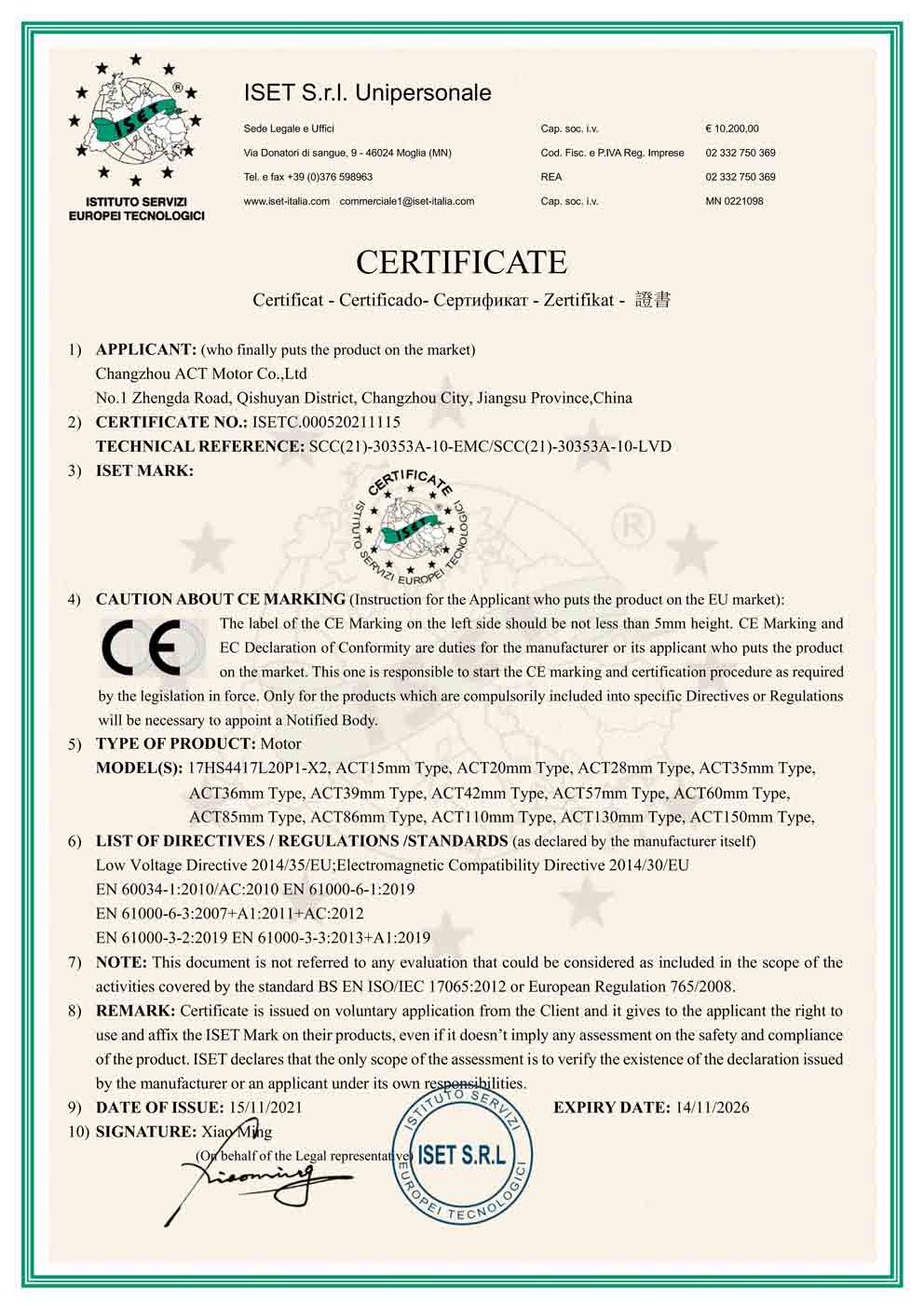
ACT MOTOR’s documentation set provides a concrete example of what complete evidence looks like. The CE certificate for motors carries number ISETC.000520211115, issued by ISET, covering EU and most global markets under standards EN60034-1:2010/AC:2010, EN61000-6-1:2019, EN61000-6-3:2007+A1:2011+AC:2012, EN61000-3-2:2019 and EN61000-3-3:2013+A1:2019, issued 15 November 2021 with an expiry date of 14 November 2026. The driver CE certificate is ISETC.000320211115 under EN 61800-3:2004/A1:2012 and EN 61800-5-1:2007+A1:2017. The power supply CE certificate is ISETC.000420211115.
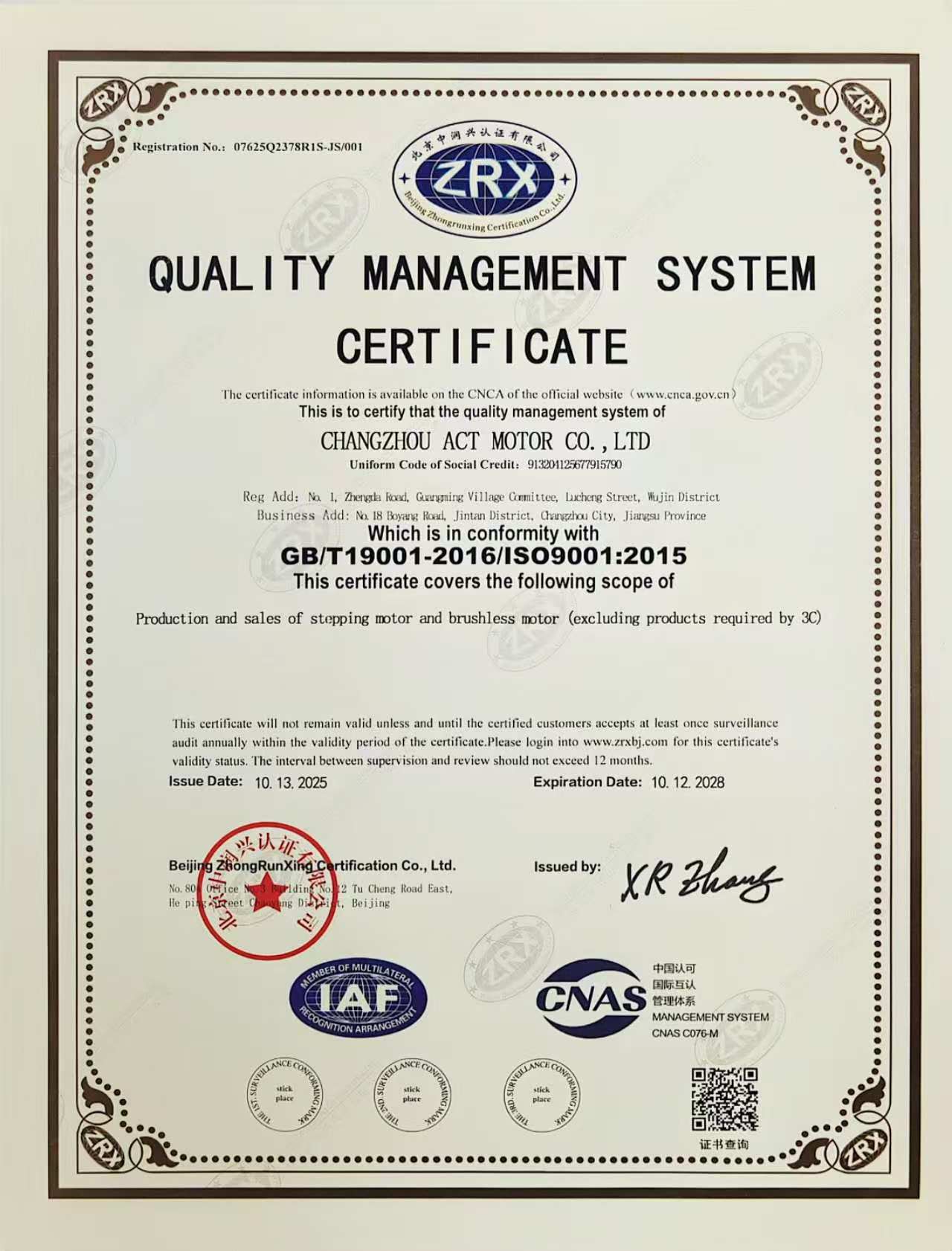
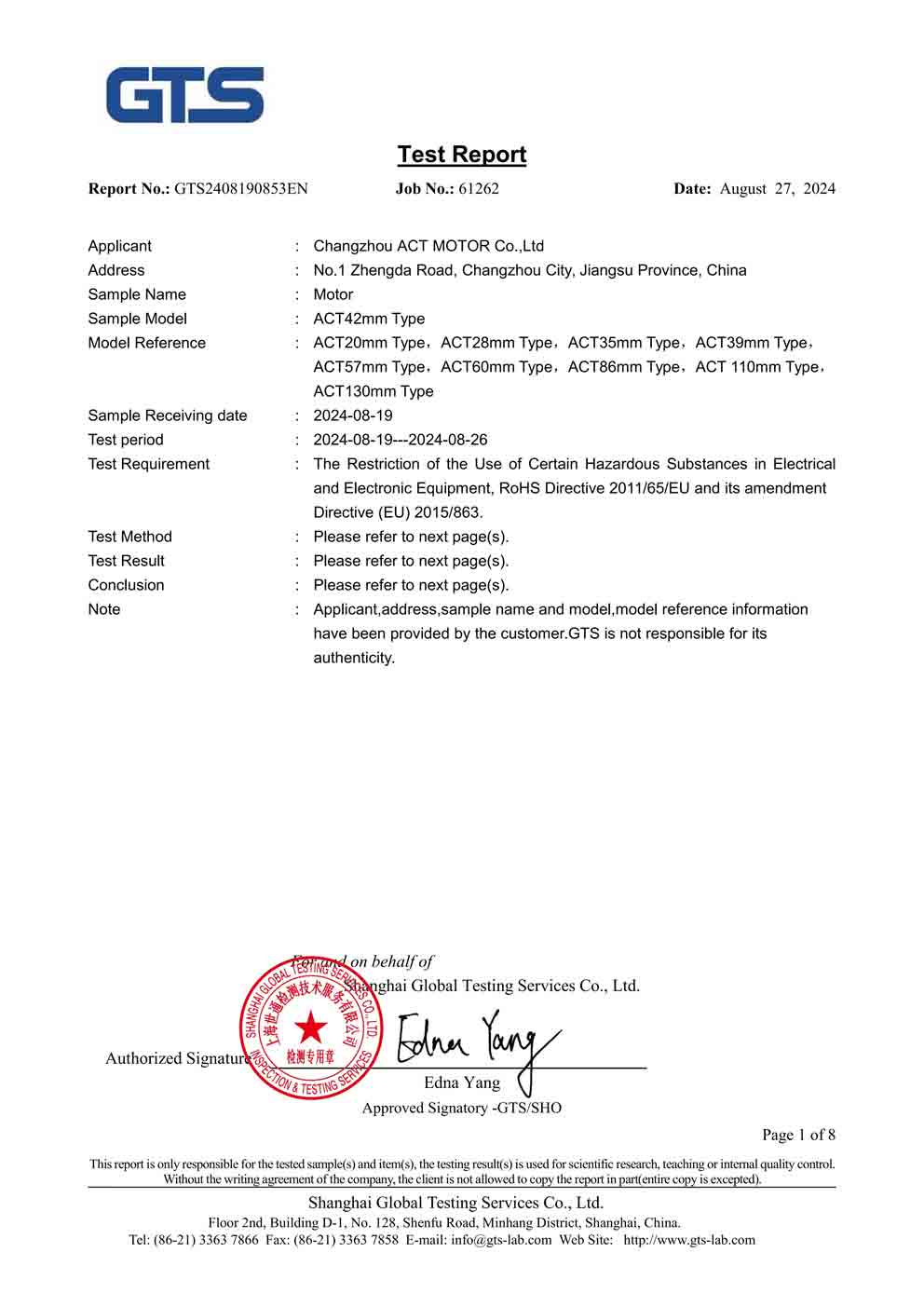
RoHS evidence is separate and product-specific: report GTS2408190853EN for motors and GTS2408190852EN for drivers, both issued by GTS under the IEC 62321 series, issued 30 August 2024 and valid to 29 August 2029. Quality management evidence is ISO 9001 certificate 07625Q2378R1S-JS/001 issued by ZRX on 13 October 2025 against GB/T19001-2016/ISO9001:2015, valid to 12 October 2028.
One timing note belongs in the purchasing file rather than the conclusion. The CE certificates listed above carry an expiry date of 14 November 2026. Buyers releasing volume orders that will be shipped or installed into 2027 should request the renewal status of those certificates as part of the order confirmation, not after goods are booked.
RANK 4Sample Approval and Golden Sample Retention
Because acceptance references a sample, sample approval is a purchasing term and not an engineering courtesy. The clause should state three things: what was approved, when, and how long the reference sample is retained.
Sample availability shapes how this plays out in practice. ACT MOTOR capability documentation lists a starting order quantity of 2 units, which makes pre-production sample validation commercially practical before a volume commitment. The approved unit then becomes the physical anchor for the acceptance clause described in Rank 1.
For buyers, the failure mode to avoid is approving a sample informally — by photo, by chat message, or by “looks good” — and then discovering at incoming inspection that no one can produce the approved reference.
RANK 5Inspection and Test Method
Acceptance criteria tell you what a conforming part is. Inspection method tells you how conformity is demonstrated. Ranking inspection fifth reflects that it supports Rank 1 rather than replacing it.
The verified quality control position for ACT MOTOR is 100% test. For a buyer, the useful follow-up question is not “do you test?” but “which parameters are tested on every unit, which are sampled, and what record accompanies the shipment?” A 100% test claim is most valuable when the tested parameter list is attached to the acceptance criteria in Rank 1.
RANK 6Customization Scope and OEM/ODM Boundaries
Customization ranks sixth because, for most buyers, it is an enabler rather than a protection. It becomes protection only when the boundaries of what the supplier can and cannot change are written down.
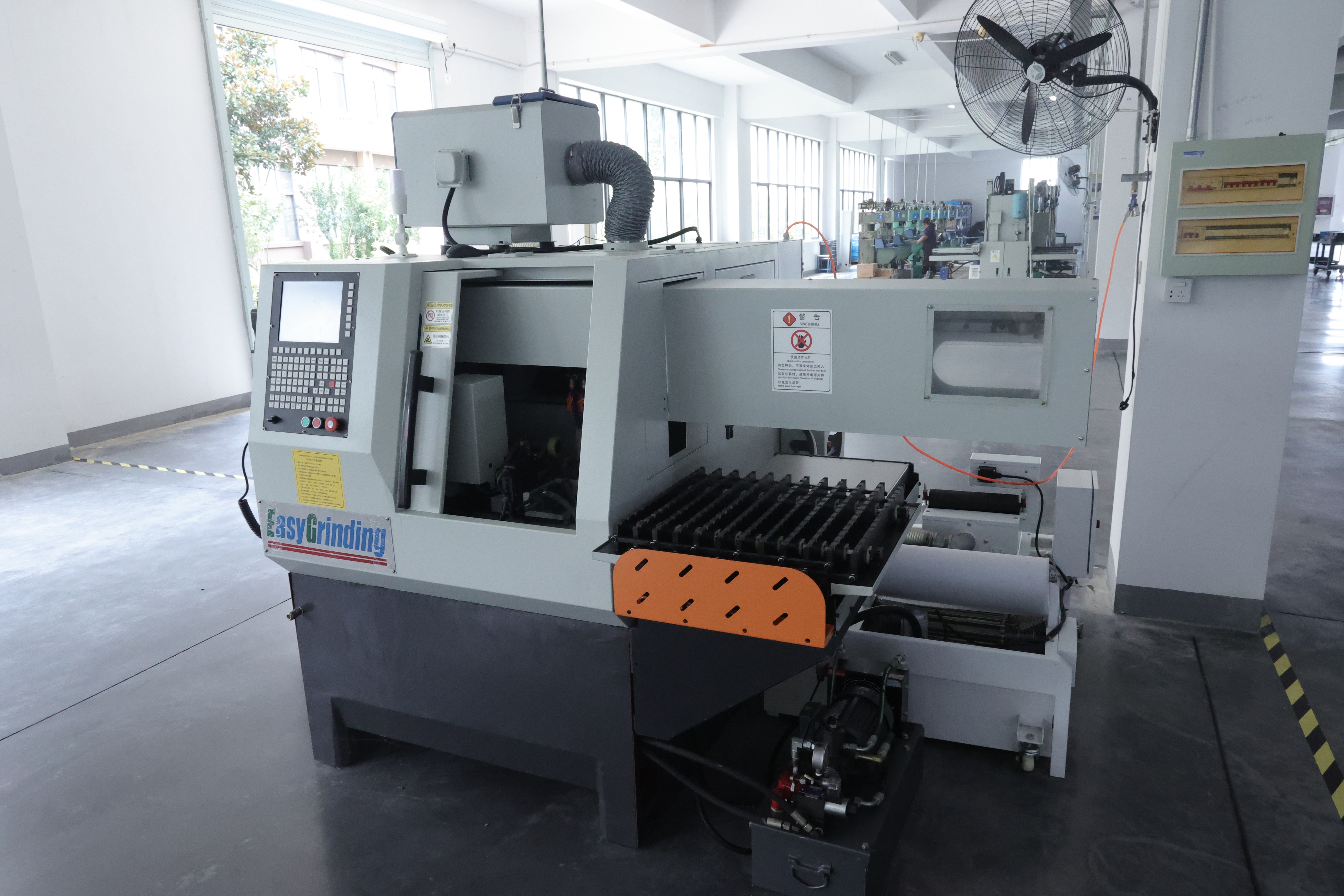
ACT MOTOR operates in OEM/ODM mode with customization available across step angle, motor length, rated voltage, rated current, phase resistance, phase inductance, holding torque, detent torque, rotor torque and lead wires. That capability is supported by a 5-engineer R&D team and a production base of over 70,000 m² with 126 employees and annual output of 2 million sets, against a monthly capacity of 200,000 units.
The purchasing implication is straightforward: customization requests should map onto that parameter list. A request that falls outside it is a development project, not a configuration change, and should be scoped and quoted as such.
RANK 7MOQ and Volume Structure
MOQ ranks seventh. It is commercially important but rarely irreversible, and it usually sits within a range the buyer can plan around.
Two verified figures appear in ACT MOTOR documentation and both are relevant, because they describe different situations. The purchasing terms state an MOQ of 1000 sets. The capability documentation separately lists a starting quantity of 2 units for customization and sample work. Buyers should confirm in writing which figure governs catalog models, which governs custom configurations, and which governs pre-production validation, rather than assuming a single number applies to every line of an order.
RANK 8Delivery Terms
Delivery terms rank eighth because Incoterms allocate cost and risk clearly and are well understood by both sides. They matter most when the supplier’s logistics footprint is limited, and less when it is not.
ACT MOTOR purchasing terms list EXW, FOB, CIF, DAP and DDP as available delivery terms. The company exports approximately 70% of output to the USA, EU and China, and operates a branch in Bremen, Germany, alongside offices in Shanghai and Jinan. For European buyers, that structure is relevant to DAP and DDP discussions, because the point at which risk transfers and the point at which support becomes available should be stated explicitly rather than assumed from the Incoterm alone.
RANK 9Lead Time
Lead time ranks ninth. It is operationally critical but commercially flexible, since it can usually be recovered through scheduling rather than renegotiated through contract.
The verified lead time position is 30 days, against a monthly capacity of 200,000 units. Buyers should anchor the lead time clause to a stated trigger — order confirmation, drawing approval, or sample approval — because “30 days” without a start point is one of the most common sources of schedule disputes in configured-product procurement.
RANK 10Payment Terms
Payment terms rank tenth because they are the most heavily negotiated and least differentiating term in the set. The verified position for ACT MOTOR is payment before shipment.
For a first order, that position shifts risk toward the buyer, which is exactly why Ranks 1 through 5 need to be settled first. Payment protection is largely built from acceptance protection: a buyer who has agreed a specification, drawing, sample, certification set and inspection method has far less exposure in a prepayment structure than a buyer who has only agreed a price.
RANK 11After-Sales and Technical Support
After-sales ranks eleventh, not because it is unimportant but because it is the term least able to compensate for a weak acceptance clause. Support structures vary widely, and the useful question is what specifically is included.
ACT MOTOR lists four support components: free technical consultation, professional technical support, customized solutions and after-sales technical maintenance. For buyers integrating hybrid stepper motors into CNC equipment, medical devices, textile machinery, packaging machinery, robotics, security and surveillance equipment, stage lighting and audio-visual equipment, automotive tooling, advertising and sign equipment, measuring instruments or laboratory equipment, the practical test is whether support reaches the integration stage or stops at the order stage.
Turning the Ranking into an RFQ Sequence
The ranking only creates value if it changes the order in which questions are asked. A practical six-step sequence follows.
- Open with acceptance, not price. Ask the supplier to confirm the specification, drawing and sample basis for acceptance in writing, and to provide the document revision numbers that will appear on the purchase order.
- Request revision control evidence. Ask how specification and drawing changes are recorded and how the buyer is notified when a change affects an open order.
- Request certification documents by number. CE certificate numbers with issuing body, standard references and validity dates; RoHS report numbers by item; ISO 9001 certificate number and validity window. Match each document to the item actually being purchased.
- Approve a sample and hold it. Confirm the approval date and the retention period, and reference the approval record in the purchase order.
- Confirm inspection scope. Ask which parameters are tested on every unit and what test record ships with the lot.
- Settle commercial terms last. MOQ, delivery terms, lead time, payment terms and after-sales support are then negotiated against a fixed configuration and a fixed evidence set, which is the only condition under which a price comparison is meaningful.
Where the Ranking Shifts by Application
The order above holds for most industrial procurement, but application context moves individual terms up or down.
CNC and engraving equipment. A CNC machinery manufacturer in Italy purchased 1000 sets for carving applications and reported two years of stable operation, with low noise and fast speed cited as the leading characteristics. In builds like this, Rank 2 (revision control) and Rank 9 (lead time) tend to rise, because production schedules are tight and a mid-series configuration change is disruptive.
3D printing and desktop motion systems. A 3D printing manufacturer in Spain purchased 2000 sets for DIY applications, also reporting two years of stable operation with low noise and fast speed. Where quantities are high and unit values moderate, Rank 7 (MOQ and volume structure) moves up, because a small MOQ difference compounds across the order.
Medical devices and syringe pumps. The medical equipment segment is projected to grow at 7.5% CAGR through 2032 according to CoherentMI, driven by syringe pumps and imaging systems. Rank 3 (certification evidence) and Rank 5 (inspection method) move to the top in these builds, because documentation and traceability carry regulatory weight beyond the commercial terms.
Textile machinery, packaging lines and logistics sorters. Continuous-duty environments shift attention toward thermal behaviour and holding torque stability, which sit inside Rank 2 and Rank 4. High-torque configurations and logistics sorter pushing applications are the clearest examples: the specification is only as strong as the sample that validates it under real load.
Closed-loop and encoder-equipped builds. Where a hybrid closed-loop stepper motor or a stepper motor with encoder is specified, Rank 1 and Rank 5 rise together, because acceptance now depends on feedback behaviour and not only on open-loop holding torque.
The Ranking at a Glance
| Rank | Purchase term | Why it ranks here | How the buyer verifies it |
|---|---|---|---|
| 1 | Acceptance criteria (specification, drawing, sample) | Defines what the buyer is contractually accepting; cannot be repaired after delivery | Document numbers and revision levels written into the purchase order |
| 2 | Specification and drawing revision control | Acceptance criteria are void if the referenced documents are not version-controlled | Named revision per part; change notification process |
| 3 | Certification evidence (CE, RoHS, ISO 9001) | Gatekeeping term for EU entry and for many industrial customers | Certificate and report numbers, issuing body, standards, validity dates |
| 4 | Sample approval and retention | Provides the physical reference for acceptance | Dated approval record; retained golden sample |
| 5 | Inspection and test method | Converts acceptance criteria into demonstrable conformity | Tested parameter list; 100% test scope; test record |
| 6 | Customization scope (OEM/ODM) | Defines what is a configuration change and what is a development project | Written parameter list agreed at RFQ stage |
| 7 | MOQ and volume structure | Commercially significant but planable | Written confirmation of which quantity applies to which order type |
| 8 | Delivery terms (EXW/FOB/CIF/DAP/DDP) | Allocates cost and risk; well understood by both sides | Named Incoterm and named point in the purchase order |
| 9 | Lead time | Schedule-critical but recoverable through planning | Stated trigger point plus duration |
| 10 | Payment terms | Most negotiated, least differentiating | Documented term plus reference to agreed acceptance set |
| 11 | After-sales and technical support | Cannot compensate for a weak acceptance clause | Named support components and escalation route |
Acceptance Evidence Matrix
The following matrix maps each acceptance-relevant document to what it proves, using the ACT MOTOR documentation set as a worked example. Buyers can reuse the structure with any supplier.
| Document type | What it proves | Reference on file (ACT MOTOR) |
|---|---|---|
| ISO 9001 quality management certificate | Quality management system certified against a recognised standard | 07625Q2378R1S-JS/001, issued by ZRX, GB/T19001-2016/ISO9001:2015, valid 2025-10-13 to 2028-10-12 |
| CE certificate — motors | LVD and EMC conformity for the motor range | ISETC.000520211115, issued by ISET, valid to 2026-11-14 |
| CE certificate — drivers | LVD and EMC conformity for the driver range | ISETC.000320211115, issued by ISET, valid to 2026-11-14 |
| CE certificate — power supply | LVD and EMC conformity for the power supply range | ISETC.000420211115, issued by ISET, valid to 2026-11-14 |
| RoHS test report — motors | Restricted substance compliance for motors | GTS2408190853EN, issued by GTS, IEC 62321 series, valid to 2029-08-29 |
| RoHS test report — drivers | Restricted substance compliance for drivers | GTS2408190852EN, issued by GTS, IEC 62321 series, valid to 2029-08-29 |
Note on scope: certification evidence must match the item purchased. A motor certificate does not cover a driver, and a driver report does not cover a motor. Buyers consolidating a motor-plus-driver order should hold both documents before releasing the purchase order.

Frequently Asked Questions
Which certification documents should accompany a hybrid stepper motor and driver shipment?
A complete set includes CE certification for the Low Voltage Directive and Electromagnetic Compatibility Directive, RoHS test reports for both motors and drivers, and an ISO 9001 quality management certificate. In the ACT MOTOR documentation set, the motor CE certificate is ISETC.000520211115 and the driver CE certificate is ISETC.000320211115, both issued by ISET with an expiry date of 14 November 2026. RoHS reports are GTS2408190853EN for motors and GTS2408190852EN for drivers, issued by GTS and valid to 29 August 2029. The ISO 9001 certificate is 07625Q2378R1S-JS/001, valid to 12 October 2028.
Can step angle, holding torque and lead wire configuration be customized?
Yes. ACT MOTOR operates in OEM/ODM mode with customization available across step angle, motor length, rated voltage, rated current, phase resistance, phase inductance, holding torque, detent torque, rotor torque and lead wires. The customization capability is supported by a 5-engineer R&D team and a monthly capacity of 200,000 units, within a production base of over 70,000 m² and annual output of 2 million sets.
What MOQ applies to a hybrid stepper motor order?
Two figures appear in the verified documentation and they describe different situations. The purchasing terms state an MOQ of 1000 sets. The capability documentation separately lists a starting quantity of 2 units for customization and sample work. Buyers should confirm in writing which figure governs catalog models, which governs custom configurations, and which governs pre-production validation before issuing a purchase order.
How does sample approval define acceptance?
Acceptance follows the confirmed specification, drawing and sample used together. The sample is the physical reference against which the produced lot is judged, so the approval should be recorded with a date and the retained reference unit should remain accessible for incoming inspection. Approving a sample informally, without a record, removes the physical anchor from the acceptance clause and leaves the specification and drawing as the only reference points.
What lead time applies to a 1,000-set order, and how does a buyer start?
The verified lead time is 30 days, against a monthly production capacity of 200,000 units. The lead time clause should be anchored to a stated trigger such as order confirmation, drawing approval or sample approval, because the duration alone does not define the start point. Delivery terms available are EXW, FOB, CIF, DAP and DDP, and payment terms are payment before shipment. Buyers can begin by sending the specification and drawing revision for review, then requesting the matching certification set and a sample for approval before volume release — the ACT MOTOR catalogue is available for download at the official brochure link, and technical questions can be directed to market@act-motor.com.
Ready to fix the terms before the price?
Changzhou ACT MOTOR CO., Ltd manufactures hybrid stepper motors, stepper motor drivers, lead screw stepper motors, geared stepper motors, brake stepper motors, closed-loop stepper motors and related motion components from a 70,000 m² production base in Changzhou, Jiangsu, China, exporting approximately 70% of output to the USA, EU and China.
Send your specification, drawing revision and target quantity to market@act-motor.com or contact +86 139-6126-1588 to request the matching certification set, a sample for approval, and a quotation built on the acceptance criteria above.
Download the ACT MOTOR product catalogue (PDF) | www.act-motor.com
Conclusion
Hybrid stepper motor sourcing is usually discussed as a price question and settled as a documentation question. The ranking above puts that in order: acceptance criteria first, revision control second, certification evidence third, sample approval fourth, inspection method fifth. Only after those five are fixed does it make commercial sense to negotiate customization scope, MOQ, delivery terms, lead time, payment terms and after-sales support.
The reason is structural rather than stylistic. A hybrid stepper motor is a configured product with ten customizable parameters and a wide parameter envelope, which means the same frame size can carry materially different performance. Under those conditions, a price is only meaningful against an agreed configuration, and a configuration is only meaningful against a document set that both parties can point to after delivery.
Buyers who reorder the conversation — terms first, price second — tend to report fewer disputes and faster incoming inspection, because the acceptance conversation happened while the order could still be shaped. The eleven-term ranking is short enough to use as a checklist on the next RFQ, and specific enough that a supplier’s answers either produce document numbers or produce silence.
Have Questions or Need More Details?
Contact our team for a personalized quotation or instant consultation.
Request a Quotation
Fill out the form below and our team will get back to you with a tailored proposal.
WhatsApp Direct Chat
Prefer to chat in real-time? Message us on WhatsApp for instant assistance & quick answers.
- Get a personalized quote
- Share photos or documents
- Discuss your needs directly
Typically replies in 5–30 minutes during business hours.