
Integrating a Hybrid Stepper Motor Driver with Your Motor: Matching, Wiring, and Tuning Trade-Offs
Integrating a Hybrid Stepper Motor Driver with Your Motor: Matching, Wiring, and Tuning Trade-Offs
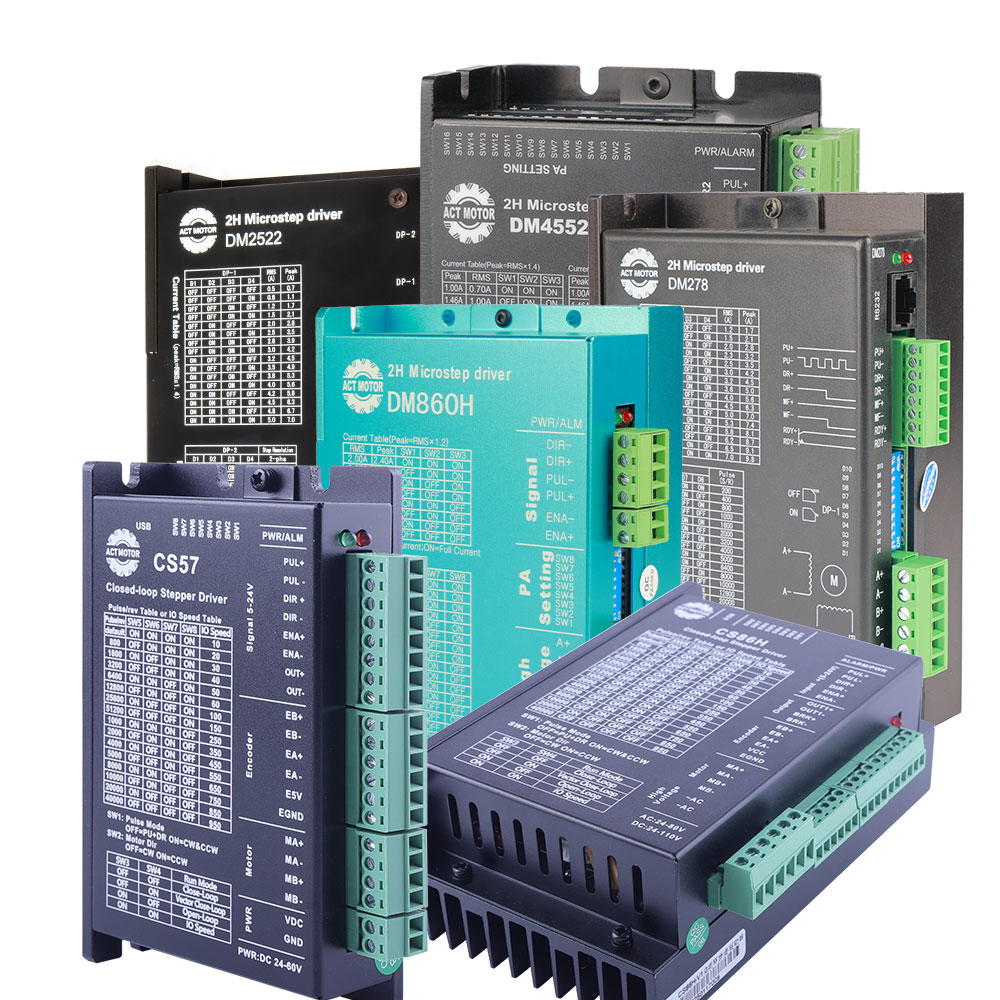
Matching a hybrid stepper motor to a driver comes down to four decisions: current rating, supply voltage, wiring topology, and microstepping plus tuning. Buyers have two routes through those decisions — a pre-matched Hybrid Stepper Motor and Hybrid Stepper Motor Driver set from one supplier, or a self-sourced motor paired with a third-party driver. Both routes move an axis. They separate on total cost of ownership, setup time, and support risk.
This guide is written for automation engineers and procurement evaluators who are choosing between those routes, or who are re-qualifying a drive train after missed steps or resonance complaints. It uses the published specifications of ACT MOTOR (Changzhou ACT Motor Co., Ltd.) as the worked example, and it marks clearly where a conclusion depends on verification you must perform yourself.
Problem definition: what integrating a driver actually involves
Integration is the set of engineering decisions that sit between two datasheets and one working axis. Four of them decide whether the machine holds position at production speed.
- Current rating match. The driver's continuous output current must cover the motor's rated current. Set the driver too low and torque falls away; set it too high and the motor runs hot while the winding insulation is stressed.
- Supply voltage window. The driver's DC supply window and the motor's rated voltage are different quantities, and the gap between them is where most why-is-it-losing-steps-at-speed questions begin.
- Wiring discipline. Lead-wire count, coil pairing, cable routing and connector practice determine whether the electrical picture on the bench still holds inside a machine cabinet.
- Microstepping and tuning. Step resolution, pulse budget, and the current-decay behaviour that decides how the axis behaves through the mid-speed band.
The usual failure mode is not a dead axis. It is an axis that runs perfectly during commissioning and starts losing position three weeks later, when the machine is warm, the load is real, and the technician who wired it has moved to another project.
Industry background: why matching has become a first-order sourcing decision
Stepper motion is a large category, and its centre of gravity is hybrid. Market Research Future values the global stepper motor market at USD 3.962 billion in 2024 and projects USD 6.245 billion by 2035, a 4.22% CAGR. Within that total, hybrid stepper motors accounted for approximately 53.93% of market value in 2025 — the largest single type segment. Asia Pacific held 48.91% of the market in 2025, which is also where a large share of motor and driver manufacturing capacity is located.
Growth is uneven across applications. The medical equipment segment is the fastest-growing application for stepper motors, with a projected 7.5% CAGR through 2032 driven by demand in syringe pumps and imaging systems — duty cycles in which a missed step is a dosing error rather than a cosmetic defect. High-torque stepper motors formed a USD 1.15 billion segment in 2024 on their own, with hybrid designs holding the dominant share.
The supplier field is concentrated around a limited number of global names. Published competitor lists for this category include MinebeaMitsumi, Sanyo Denki, Oriental Motor, Moons' Industries and Nidec Corporation. For a procurement team, the practical consequence is straightforward: motors and drivers are frequently bought from different organisations, and the interface between them is nobody's default responsibility unless you assign it deliberately.
The matched set: what ACT MOTOR's motor and driver specifications cover
Changzhou ACT Motor Co., Ltd. is a manufacturer of electronic control products for industrial automation, founded in 2010 and based in Changzhou, Jiangsu, China. The company operates a 70,000 m² production site with 126 employees, a five-engineer R&D team and an annual output of 2 million sets; roughly 70% of output is exported, with the USA, EU and China as main markets, supported by a branch in Bremen, Germany and offices in Shanghai and Jinan. It holds ISO 9001 certification and states CE and RoHS compliance for its products.
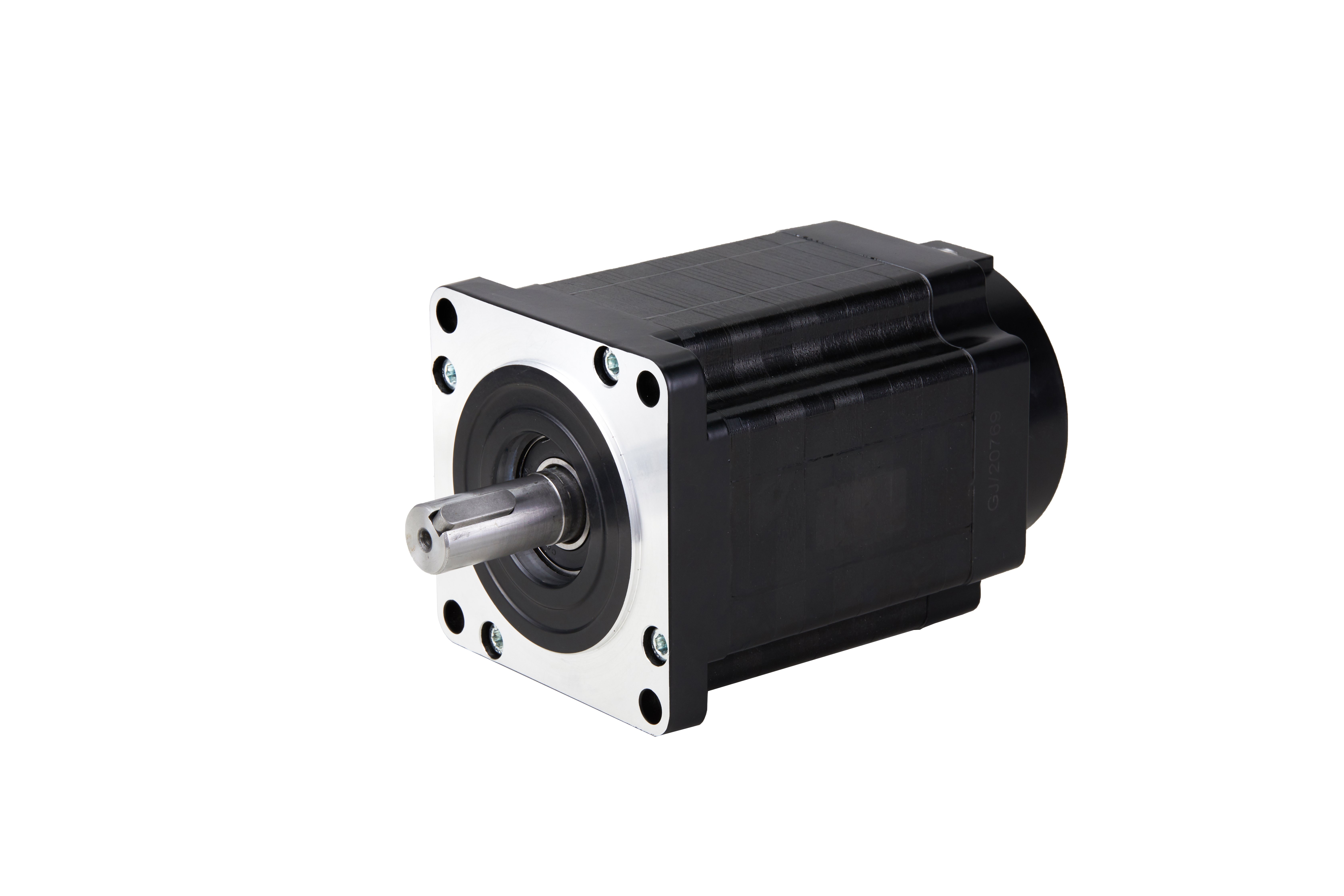
Its Hybrid Stepper Motor range covers the 8HS, 11HS, 14HS/HM, 15HS/HM, 16HS/HM, 17HS/HM, 23HS/HM/HY, 24HS, 34HS/HM/HY/HD, 42HS and 52HS families, plus the 17HT, 23HT, 34HT, 42HT and 50HT high-torque models. The published specification windows are:
| Parameter | Published window |
|---|---|
| Step angle | 0.9° – 2.4° |
| Motor length | 34 mm – 220 mm |
| Rated voltage | 2 V – 8 V |
| Rated current | 0.5 A – 8 A |
| Phase resistance | 0.05 Ω – 10 Ω |
| Phase inductance | 0.1 mH – 10 mH |
| Holding torque | 0.08 N·m – 28.0 N·m |
| Detent torque | 0.01 N·m – 0.75 N·m |
| Rotor inertia | 0.004 kg·cm² – 10 kg·cm² |
| Lead wires | 3 – 8 wires |
| Weight | 0.1 kg – 15.0 kg |
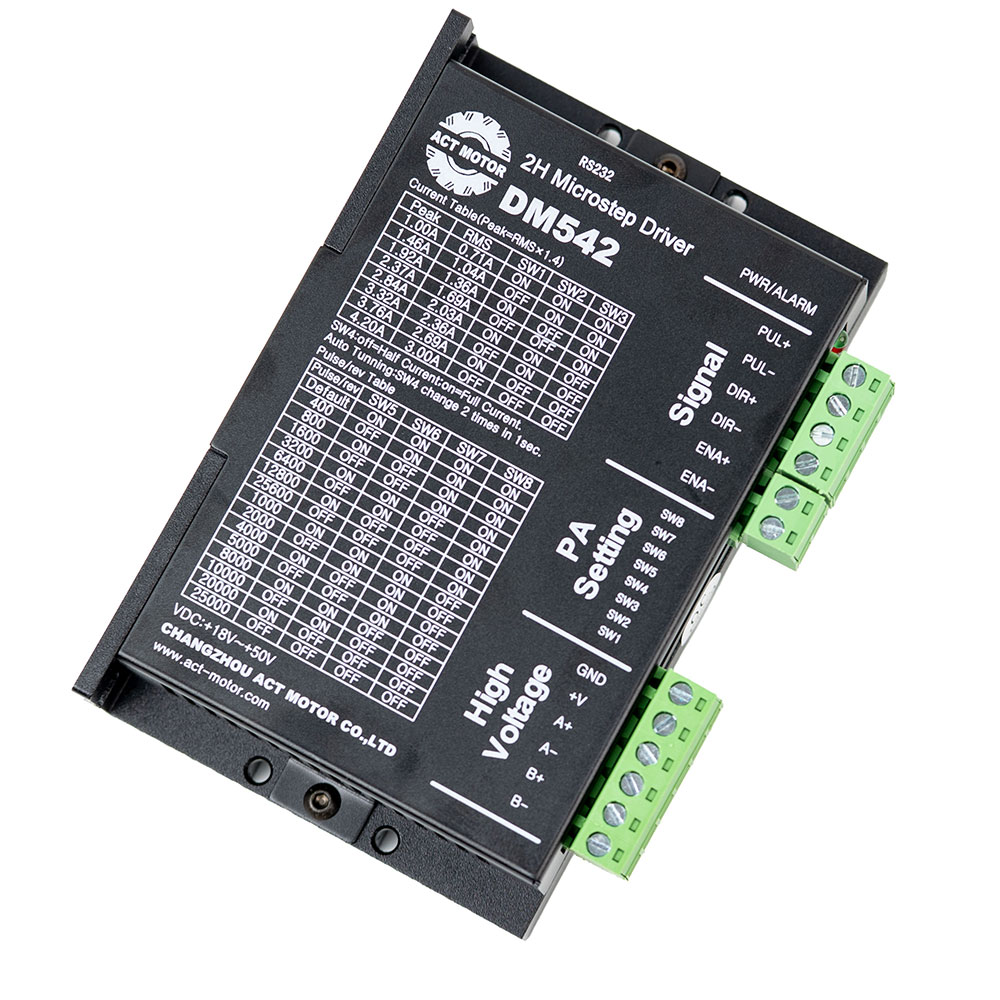
The Hybrid Stepper Motor Driver unit covers the DM542, DM556, HS758 and HS56 models, with a published supply window of 12–36 V and a continuous output current of 0.3–8.4 A.
Read together, the two windows overlap in the way a matched set is supposed to. The motor's rated current band of 0.5–8 A sits inside the driver's 0.3–8.4 A continuous output window, so no motor in the range falls outside the driver family's current capability. The driver's 12–36 V supply window sits above the motor's 2–8 V rated voltage band, which is the expected relationship when the driver, rather than the motor winding, carries the current-regulation job. These are selection windows, not guarantees: a specific axis still needs its own current setting, and the overlap tells you the pair is worth evaluating rather than that it is automatically correct.
Mechanical and functional variants share the same electrical foundation. Geared stepper motors (8HSAG through 42HSAG) add a reduction stage with ratios from 1:3 to 1:512. Lead screw motors run from 8HSL to 34HSL, and ball screw variants from 11HSLG to 34HSLG. Closed-loop models (8SSM through 42SSM) add position feedback, and brake motors are available in the 17HS, 23HS and 34HS frame sizes. RoHS-compliant and ISO 9001 production types are listed separately in the range. The effect for an integrator is that the same driver interface is reused across a wide mechanical envelope, so a change in mechanics does not automatically mean a change in wiring habit or tuning method.
Matching, step 1: current rating
Start with the motor's rated current and the driver's continuous output current, and treat the two as a pair rather than as independent specifications. ACT MOTOR's hybrid stepper motors are rated from 0.5 A to 8 A, and the Hybrid Stepper Motor Driver range is rated for 0.3–8.4 A continuous. A driver chosen from the same catalogue therefore has margin at the top of the motor range and a low end that reaches below the smallest rated motor in the range.
In a self-sourced pairing the comparison is identical but the sourcing is not: both numbers now come from documents produced by different organisations, using different conventions for continuous versus peak current, per-phase versus total current, and with or without a specified heatsink condition. The engineering work is the same; the verification work is not. The practical rule is to set the driver at the motor's rated current, reduce it if the motor case temperature climbs beyond what the application tolerates, and never leave the setting at a factory default that was chosen for a different motor.
Matching, step 2: supply voltage and headroom
Motor rated voltage and driver supply voltage are not the same parameter, and treating them as interchangeable is one of the most common early mistakes. ACT MOTOR's hybrid stepper motors are listed with rated voltages of 2 V to 8 V, while the driver unit is listed with a 12–36 V supply window. The motor winding is a low-voltage, current-driven element; the driver's DC bus supplies the voltage headroom needed to push current into that winding quickly enough as step rate rises.
The consequence for matching is that whether the axis turns at all is a low bar. What matters is whether the chosen supply provides enough headroom to reach the intended step rate with useful torque, and whether the driver keeps current inside the motor's rating when the bus sits at its maximum. A self-sourced pairing leaves both questions with the buyer; a matched set answers them from a single set of published windows.
Matching, step 3: inductance and the speed you actually need
Phase inductance decides where torque falls away. ACT MOTOR's hybrid stepper motor range spans 0.1 mH to 10 mH in phase inductance and 0.05 Ω to 10 Ω in phase resistance — a two-decade spread that maps onto very different speed capabilities. A low-inductance winding reaches higher step rates on the same supply; a high-inductance winding trades speed for smoother low-speed behaviour and lower current ripple.
This is where matching stops being a catalogue exercise. Two motors with the same holding torque can behave differently at the same step rate purely because of winding inductance, and the driver's supply voltage determines whether current can rise fast enough within each electrical cycle. When a self-sourced axis stalls at speed, inductance and supply headroom are usually the first two things worth checking — not the motor's headline torque rating.
Wiring: where self-sourced pairings usually break
ACT MOTOR's hybrid stepper motors are listed with 3 to 8 lead wires. That range is not a detail: lead count determines how the coils can be connected, and therefore what the driver actually sees.
- Match the connection scheme to the driver's output stage. A driver expects a specific coil configuration. Before applying power, confirm which leads form each phase and how they are paired. A coil mistake usually shows up as weak, rough or absent motion, and occasionally as an unusually warm driver.
- Treat unused leads deliberately. On motors with more leads than the chosen connection uses, surplus conductors should be insulated and secured rather than left loose inside a cabinet.
- Keep motor leads away from signal wiring. Step and direction signals are low-level; motor phases switch several amps. Separated routing and shielded cable are the least expensive reliability measures available at this stage.
- Use consistent connector practice. A matched set gains its advantage from repeatability, which means documented pinouts — because the second machine is usually built by a different technician than the first.
- Never hot-plug the motor. Disconnecting a motor from an energised driver is a recognised way to damage the output stage. Power down before changing any connection.
Microstepping: smoothness, torque and pulse budget
Microstepping interpolates between full steps, and the trade-off is real in both directions. Higher microstep settings improve smoothness and reduce audible noise and low-speed vibration, which matters in applications such as medical dosing, where the ACT MOTOR medical application record calls for constant torque output, extremely smooth low-speed operation, low pulsation and low vibration. The costs are a smaller torque increment per microstep and a higher pulse rate demanded from the controller for the same shaft speed.
The motor side sets the baseline. ACT MOTOR's hybrid stepper motor range spans step angles of 0.9° to 2.4°, so two motors from the same range can differ in native resolution before any driver setting is applied. The equipment-manufacturing application record in the same product family lists compatibility with microstepping drivers and stable behaviour at high speed as requirements — a reminder that microstepping is a system setting, not a driver feature you enable once and forget.
Tuning: resonance and missed steps
Resonance is a mechanical and electrical interaction, and stepper drive trains are exposed to it in the mid-speed band. The symptom is characteristic: an axis that runs cleanly at low speed and at high speed but stutters, growls or loses position across a narrow range in between.
Three levers are available, and all three are cheaper to apply during commissioning than after the line is running.
- Change the microstep setting. A different interpolation granularity moves the excitation profile and often shifts the problem band away from the operating speed.
- Change the mechanical ratio. ACT MOTOR's geared stepper motors cover reduction ratios from 1:3 to 1:512, which lets the motor run outside the problematic band while the load still turns at the required speed.
- Change the drive architecture. Closed-loop hybrid stepper motor models (8SSM through 42SSM) add position feedback, which addresses the symptom directly when the application cannot tolerate a missed step at all.
What is not a lever is raising current without limit. Increasing the driver's current setting above the motor's rating adds heat and does not fix a resonance problem. Missed steps that persist after microstepping and ratio changes usually point to a wiring fault, a current setting chosen for a different motor, or a load the drive train was never sized for.
The integration sequence, in order
- Confirm the mechanical requirement: load torque, shaft speed range, and the step resolution the process actually needs.
- Select the motor from the range — frame size, length, holding torque, and the phase inductance that suits the required speed.
- Confirm the motor's rated current and choose the driver model whose continuous output current covers it, using the 0.3–8.4 A window as the reference.
- Confirm the driver's 12–36 V supply window against the controller power supply, and size the supply for the current setting you intend to use.
- Establish the coil map: which leads form which phase, and which connection scheme the driver expects.
- Wire with separation between power and signal runs, secure unused leads, and document the pinout.
- Set the driver current to the motor's rated value as the starting point.
- Choose a microstep setting that matches both the controller's pulse-rate capability and the smoothness the process needs.
- Run the axis through the full speed range, not only at the operating point, and record where it behaves roughly.
- Adjust microstepping, then mechanical ratio, then drive architecture, in that order, until the full range is clean.
- Freeze the settings, write them down, and apply the same values to the next machine.
Pre-matched set versus self-sourced pairing: a decision table
The table below compares the two routes across the decisions that consume engineering time. The right-hand column is framed as what you must verify, because that is the difference that appears on a project schedule rather than on a quotation.
| Decision point | Pre-matched ACT MOTOR set | Self-sourced motor plus third-party driver |
|---|---|---|
| Current rating match | Motor range 0.5–8 A sits inside driver range 0.3–8.4 A continuous; both windows published by one supplier | Two datasheets from two suppliers; confirm continuous versus peak conventions and heatsink conditions |
| Supply voltage | Driver supply window 12–36 V published alongside motor rated voltage 2–8 V | Confirm the driver supply window and the controller power supply independently |
| Coil and lead-wire configuration | Motors listed with 3–8 lead wires; connection scheme confirmed with the same supplier as the driver | Establish the coil map yourself; wiring errors are a leading cause of rough motion |
| Microstepping and tuning | Motor step angle range 0.9°–2.4° and driver settings resolved against one product family | Resolve microstepping against two sets of instructions and two terminologies |
| Resonance remedies | Related options in the same catalogue: geared motors at 1:3–1:512, lead screw and ball screw variants, closed-loop 8SSM–42SSM | Remedies sourced from a second supplier and re-validated against the first supplier's motor |
| Compliance documentation | ISO 9001 certification with CE and RoHS compliance stated; EU requirements are Directives 2014/35/EU (LVD), 2014/30/EU (EMC) and 2011/65/EU (RoHS) | Collect declarations of conformity from each supplier and confirm they cover the delivered part numbers |
| Support ownership | One technical contact for the complete drive train | Split responsibility; interface problems can fall between the two parties |
| Repeat-order consistency | Same catalogue, same recorded settings, documented pinout | Re-verify each batch against the original pairing assumption |
Use cases: where each route fits
Application records in the ACT MOTOR corpus show the matched approach in production, and they also show why the pairing is specified at component level rather than left to the machine builder.
Medical peristaltic pumps. The medical equipment application record specifies precision flow control on a pulse driver, names DM542 as the matched equipment, and lists requirements of constant torque output, extremely smooth low-speed operation, low pulsation, low vibration and no step loss over long continuous operation. In this class of application the driver setting is a quality parameter, not a preference.
Industrial automation, X/Y/Z motion. The industrial automation record lists DM542, DM860H and DM2722 units as matched equipment, with requirements covering high load capacity, high rigidity, continuous duty, low heat generation and high insulation. Here the driver is chosen for thermal and insulation margin as much as for torque.
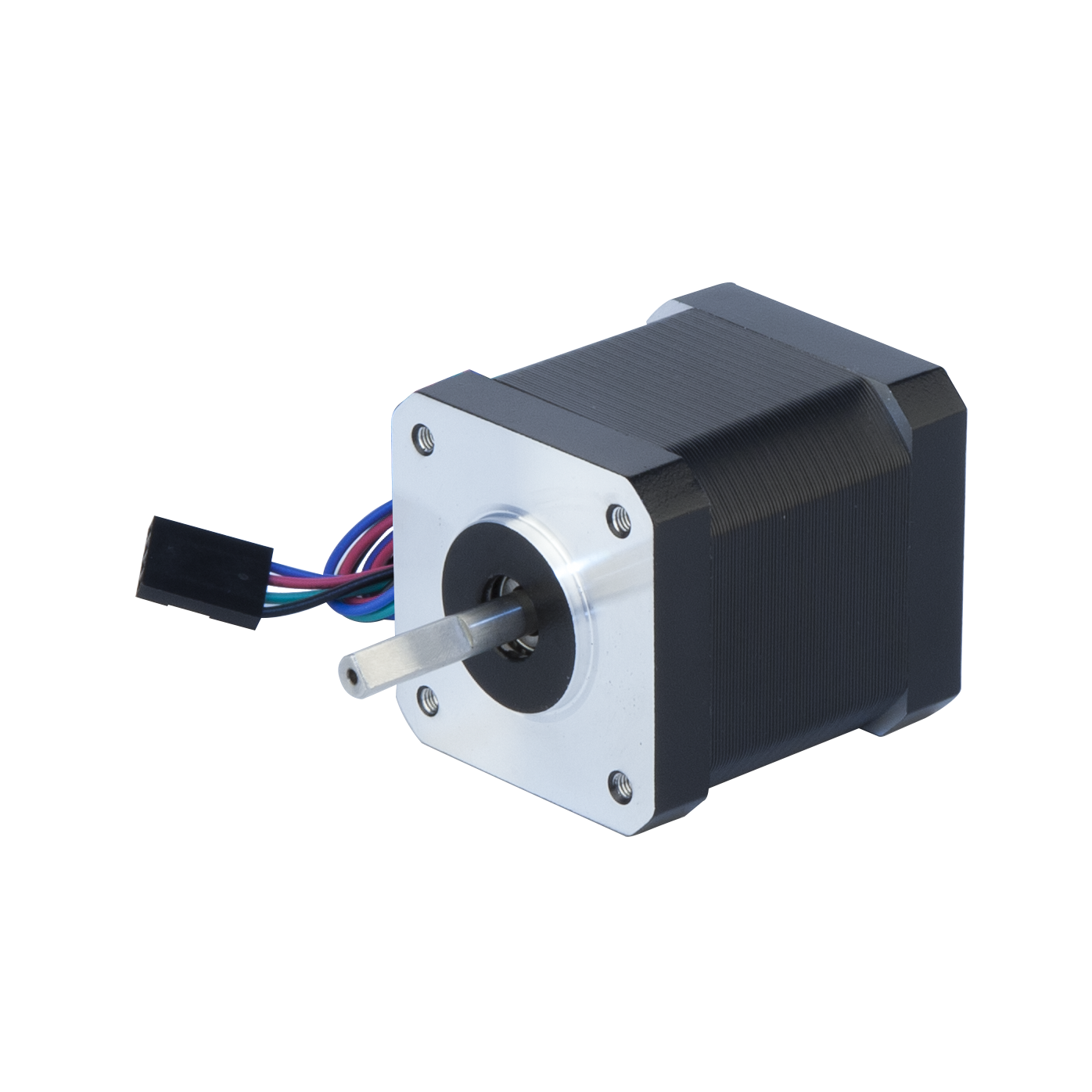
Equipment manufacturing and 3D printing. The equipment-manufacturing record requires high-precision positioning, low vibration, no step loss at high speed, stable extrusion torque and compatibility with microstepping drivers, with DM542 or DM420 listed as matched equipment and different emphases on the X, Y, Z and E axes. That last detail is the argument for the matched route in miniature: four axes, one supplier's settings, four different tuning emphases.
The verdict: total cost of ownership, setup time, and support risk
Neither route is wrong, but they fail differently, and the difference is measurable in three places.
Total cost of ownership. A self-sourced pairing can win on unit price and lose on the engineering hours needed to verify current conventions, establish a coil map, resolve microstepping against two manuals, and re-validate whenever either supplier changes a part. Those hours are real, they land on your engineers, and they recur each time the drive train is reused on a new machine. A matched set moves that work to the supplier once.
Setup time. The matched route shortens commissioning because settings, wiring scheme and tuning method are established against one product family rather than assembled from two. The self-sourced route can be equally fast when the same engineer builds every machine — and becomes progressively slower as the team grows and the original assumptions are no longer in one person's head.
Support risk. This is the largest asymmetry. If a self-sourced axis loses steps, the motor supplier will point at the driver and the driver supplier will point at the motor, and the diagnostic work lands on you. With one supplier accountable for both motor and driver, the question of whether a pairing is correct for your application has a single owner.
A self-sourced pairing makes sense when the driver is already standardised across a plant, or when a specific third-party driver is mandated by an existing control platform. In those cases the verification work does not disappear — it simply needs to be planned and budgeted rather than discovered during commissioning.
FAQ
Do hybrid stepper motors and drivers need CE and RoHS documentation for EU-bound equipment?
Yes, and the requirement attaches to the assembled machine as well as to the components. Industrial hybrid stepper motors must comply with EU Directives 2014/35/EU (Low Voltage Directive) and 2014/30/EU (Electromagnetic Compatibility) for CE marking, and with 2011/65/EU for RoHS compliance. Changzhou ACT Motor Co., Ltd. holds ISO 9001 certification and states CE and RoHS compliance for its products, so the declaration trail for the motor and driver side is available from one supplier. In a self-sourced pairing, declarations must be collected from each supplier and checked against the actual delivered part numbers.
Can one driver family really cover the whole hybrid stepper motor range?
Within ACT MOTOR's published windows, yes. The Hybrid Stepper Motor Driver range (DM542, DM556, HS758 and HS56) is rated 0.3–8.4 A continuous output with a 12–36 V supply window, and the Hybrid Stepper Motor range is rated 0.5–8 A, so no motor in the range falls outside the driver family's current capability. That is a statement about selection windows, not a guarantee for a specific axis: the driver's current setting must still be matched to the individual motor's rated current, and the result verified across the full speed range of the machine.
What actually drives total cost of ownership in a motor and driver pairing?
Three costs dominate, and only one of them is the purchase price. The first is engineering time: verifying current-rating conventions, establishing a coil map for a motor with 3–8 lead wires, and resolving microstepping against two sets of documentation. The second is re-validation cost, incurred whenever a supplier changes a part or a drive train is reused on a new machine. The third is downtime cost, which is decided by how quickly a missed-step or resonance problem can be diagnosed — a question of who owns the interface between motor and driver.
Can we validate a matched motor and driver set before committing to a production order?
That is the normal starting point for a matched-set evaluation, and it is where a supplier's technical support is genuinely tested. The useful sequence is to state the load torque, the required shaft speed range and the step resolution the process needs; receive a motor and driver recommendation with the current setting and microstep configuration stated; then run the axis through its full speed range rather than only at the operating point. ACT MOTOR supplies hybrid stepper motors, stepper motor drivers and the related geared, lead screw, ball screw and closed-loop variants from one catalogue, and technical queries can be raised directly at market@act-motor.com.
How do we keep behaviour consistent across repeat orders?
Consistency comes from three things that are cheap to do once and expensive to reconstruct later: a documented pinout for every axis, a recorded driver current and microstep setting, and a motor specification reordered by the same model designation rather than by a note saying the same as last time. Because one supplier's catalogue covers motors from 0.08 N·m to 28.0 N·m holding torque across the same driver interface, settings and wiring habits transfer between machines instead of being rebuilt for each one.
Conclusion and next step
Integrating a hybrid stepper motor driver is not difficult, but it is a chain of decisions in which each link depends on the previous one: current rating, supply voltage, inductance, wiring, microstepping and tuning. A pre-matched set collapses that chain into one supplier's published windows and one technical contact. A self-sourced pairing leaves the chain intact but moves every verification step onto your engineering team — a reasonable trade only when the driver is already standardised, or when the engineering hours are explicitly planned and budgeted.
For a first evaluation, the most efficient path is to test the pairing against a real axis load rather than comparing datasheets side by side. ACT MOTOR's full hybrid stepper motor and driver documentation is available as a downloadable brochure, and matched-set recommendations can be requested with your load torque and speed range.
Next step: send your load torque, step resolution and supply voltage to ACT MOTOR and request a matched motor-and-driver recommendation for your axis, or ask for a sample set to validate on your own test bench.
Download the product catalogue: ACT MOTOR Hybrid Stepper Motor and Driver Brochure (PDF)
Contact: market@act-motor.com | Tel / WhatsApp: +86 139-6126-1588 | No.18, Boyang Road, Jintan Area, Changzhou, Jiangsu, China | www.act-motor.com
Have Questions or Need More Details?
Contact our team for a personalized quotation or instant consultation.
Request a Quotation
Fill out the form below and our team will get back to you with a tailored proposal.
WhatsApp Direct Chat
Prefer to chat in real-time? Message us on WhatsApp for instant assistance & quick answers.
- Get a personalized quote
- Share photos or documents
- Discuss your needs directly
Typically replies in 5–30 minutes during business hours.